Manual Testing and Verification
This document provides systematic manual testing for validating CruisePlan functionality during development and before releases. It relies on standardised test fixtures to ensure that:
Core CLI commands work correctly together
Complex cruise configurations are processed accurately
Output generation functions as expected
The testing approach uses the test_all_fixtures.py script combined with structured test cases to verify cruise planning workflows systematically.
Run Tests
Test Fixtures Location:
Test Files:
tests/fixtures/tc*.yamlOutput Directory:
tests_output/fixtures/Test Script:
test_all_fixtures.py(repository root)
To run all manual tests:
# Run automated fixture testing
python test_all_fixtures.py

# Verify outputs
ls tests_output/fixtures/
This generates 54 output files (9 per test case in tests/fixtures/tc*.yaml).
Automated Processing: The
test_all_fixtures.pyscript processes alltc*.yamlfiles automaticallySystematic Coverage: Test cases progress from simple to complex scenarios
Workflow Validation: Each test verifies the complete
process→scheduleworkflowOutput Verification: Generated files then need to be manually checked for existence and validity. Specific verification steps are provided per test case below.
Test Case 1: Single Station (tc1_single.yaml)
Purpose: Verify basic architecture with minimal complexity (enables manual checks)
Configuration:
Single leg with one CTD station
Check YAML enrichment and output generation
Check CTD duration calculation
TC1_Single_Test_enriched.yaml
Verify that in STN_001 the coordinates were enriched as:
coordinates_ddm: 45 00.00'N, 045 00.00'W
Verify that the port got expanded, including
ports:
   - name: port_cadiz
     latitude: 36.5298
     longitude: -6.2923
     display_name: Cadiz, Spain
Verify that the defaults got added, including
turnaround_time: 30.0
ctd_descent_rate: 1.0
ctd_ascent_rate: 1.0
TC1_Single_Test_schedule.html
Verify that the CTD takes 2.1 hours, based on a 30 minute “turnaround_time” (the default from cruiseplan/config/values.py) and a 2850m CTD (using mocked bathymetry) from DEFAULT_CTD_RATE_M_S in cruiseplan/config/values.py, which is 47.5 minutes down and 47.5 minutes up, plus 30 minutes turnaround = 125 minutes or 2.1 hours.
Verify that the total cruise duration is 262.4 hours / 10.9 days.
Compare with the HTML schedule output to verify CTD timing calculations.
TC1_Single_Test_schedule.csv
Verify that the first row, second to last entry is -34.51 (Longitude minutes for -63.5752 degrees)
activity,label,operation_action,start_time,end_time,Transit dist [nm],Vessel speed [kt],Duration [hrs],Depth [m],Lat [deg],Lon [deg],Lat [deg_rounded],Lat [min],Lon [deg_rounded],Lon [min],leg_name
Port,port_halifax,Port mob,1970-01-01T00:00:00,1970-01-01T00:00:00,0.0,0,0.0,0,44.6488,-63.5752,44,38.93,-63,-34.51,Leg_Single
Transit,Transit to STN_001,Transit,1970-01-01T00:00:00,1970-01-04T06:57:00,789.6,10.0,79.0,,44.6488,-63.5752,44,38.93,-63,-34.51,Leg_Single
Station,STN_001,Station profile,1970-01-04T06:57:00,1970-01-04T09:02:00,0.0,0,2.1,2850,45.0,-45.0,45,0.0,-45,-0.0,Leg_Single
Transit,Transit to port_cadiz,Transit,1970-01-04T09:02:00,1970-01-11T22:21:00,1813.1,10.0,181.3,,45.0,-45.0,45,0.0,-45,-0.0,Leg_Single
Port,port_cadiz,Port mob,1970-01-11T22:21:00,1970-01-11T22:21:00,0.0,0,0.0,0,36.5298,-6.2923,36,31.79,-6,-17.54,Leg_Single
TC1_Single_Test_stations.tex
Verify that the LaTeX station table includes water depth 2850
Verify the Latex-formated coordinate includes 45$^circ$00.00’N:
Station & STN-001 & 45$^\circ$00.00'N, 045$^\circ$00.00'W & 2850 \\
TC1_Single_Test_work_days.tex
Verify that the LaTeX work days table includes total cruise duration of 2.1 operation hours and 260.3 transit hours:
\textbf{Total duration} & & \textbf{2.1} & \textbf{260.3} \\
Figures _map.png and _schedule.png
Verify that the map PNG shows no ports TC1_Single_Test_map.png
Verify that the schedule PNG shows ports TC1_Single_Test_schedule.png
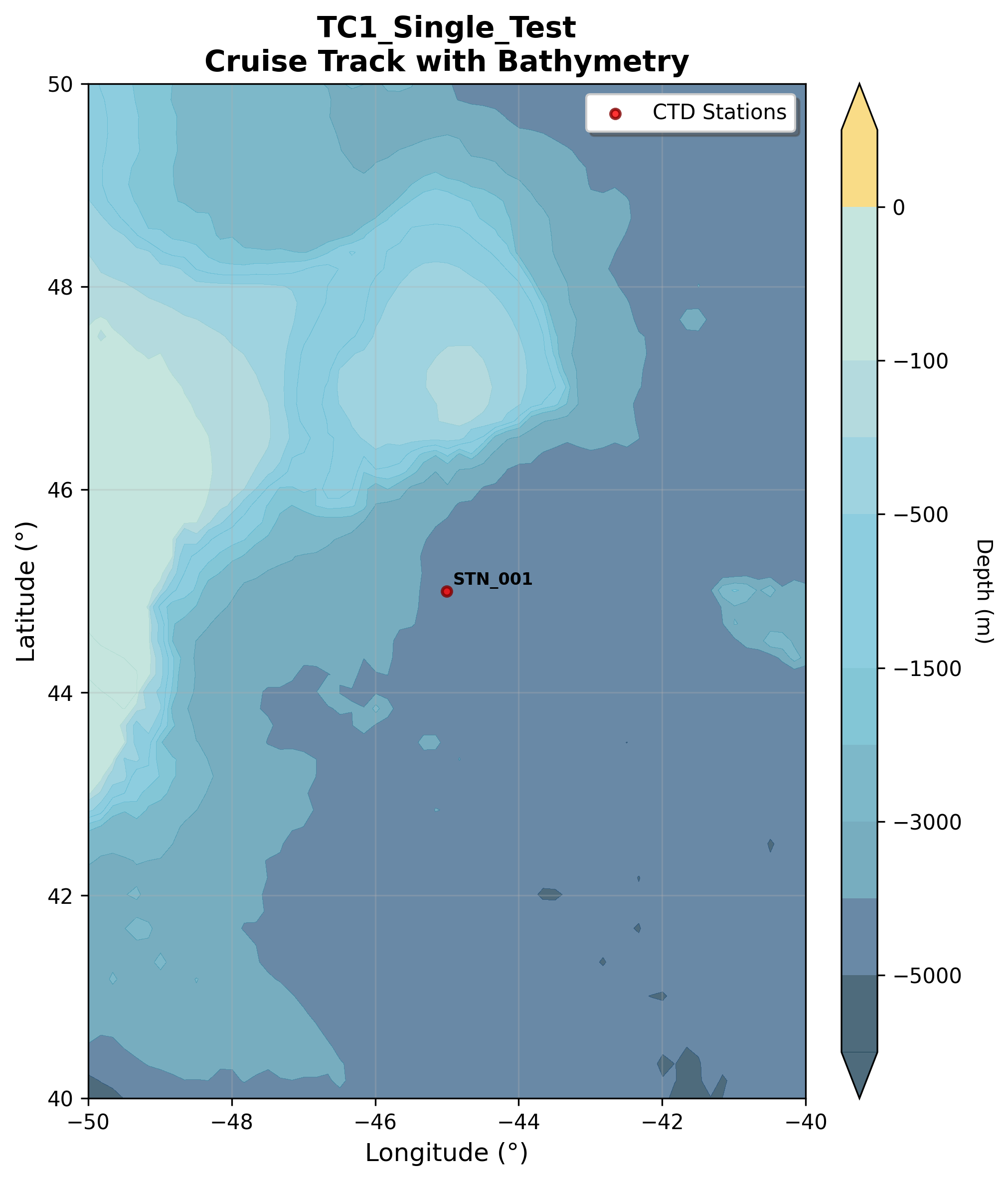

KML: TC1_Single_Test_catalog.kml
Verify that the KML file includes the station details

KML output viewed in Google Earth showing station location and details.
Test Case 2: Two Legs (tc2_two_legs.yaml)
Purpose: Verify multi-leg routing with distinct operations
Configuration:
Two legs with different departure/arrival ports
CTD operation in first leg
Mooring deployment in second leg
Manual verification:
Verify that the *.html shows total duration of 1440.4 hours (because the default mooring time is 999.0 hours)
Verify that two legs are generated with 277.2 hours in Leg 1 and 1163.2 hours in Leg 2.
Verify that the _schedule.png matches TC2_TwoLegs_Test_schedule.png
Verify that the _work_days.tex has a total duration with operations of 1000.0 hours and transit duration of 440.4 hours.

Test Case 3: Clusters (tc3_clusters.yaml)
Purpose: Verify cluster-based organization and operation sequencing
Configuration:
Multiple legs with cluster-based activity organization
Sequential strategy testing
Duplicate station handling
Different routing strategies
Manual verification:
Check the *.html output for each routing strategy:
Verify that the *.html shows total duration of 754.2 hours.
Verify that the average speed for the transit is 10.3 kts
Verify that Leg_Survey_Faster is faster than Leg_Survey by 20.8 hours due to a default leg speed of 12 kts instead of 10 kts.
Verify that 3e. Leg_Survey_Duplicate4 repeats STN_001, adding a total of 0.5 hours to the duration (making it 128.4 hours).
Verify that the 3f. Leg_Survey_Reorder does the stations in order of STN_004 then STN_003 then STN_002 then STN_001.
See the HTML output TC3_Clusters_Test_schedule.html for reference.
Test Case 4: Mixed Operations (tc4_mixed_ops.yaml)
Purpose: Verify handling of diverse operation types
Configuration:
CTD, mooring, and other operation types
Mixed durations and activities
Complex scheduling scenarios
Manual verification:
Verify that the *_map.png shows a shaded area, a line and a station. Compare to TC4_Mixed_Test_map.png
Verify that the *_stations.tex shows 3 lines with:
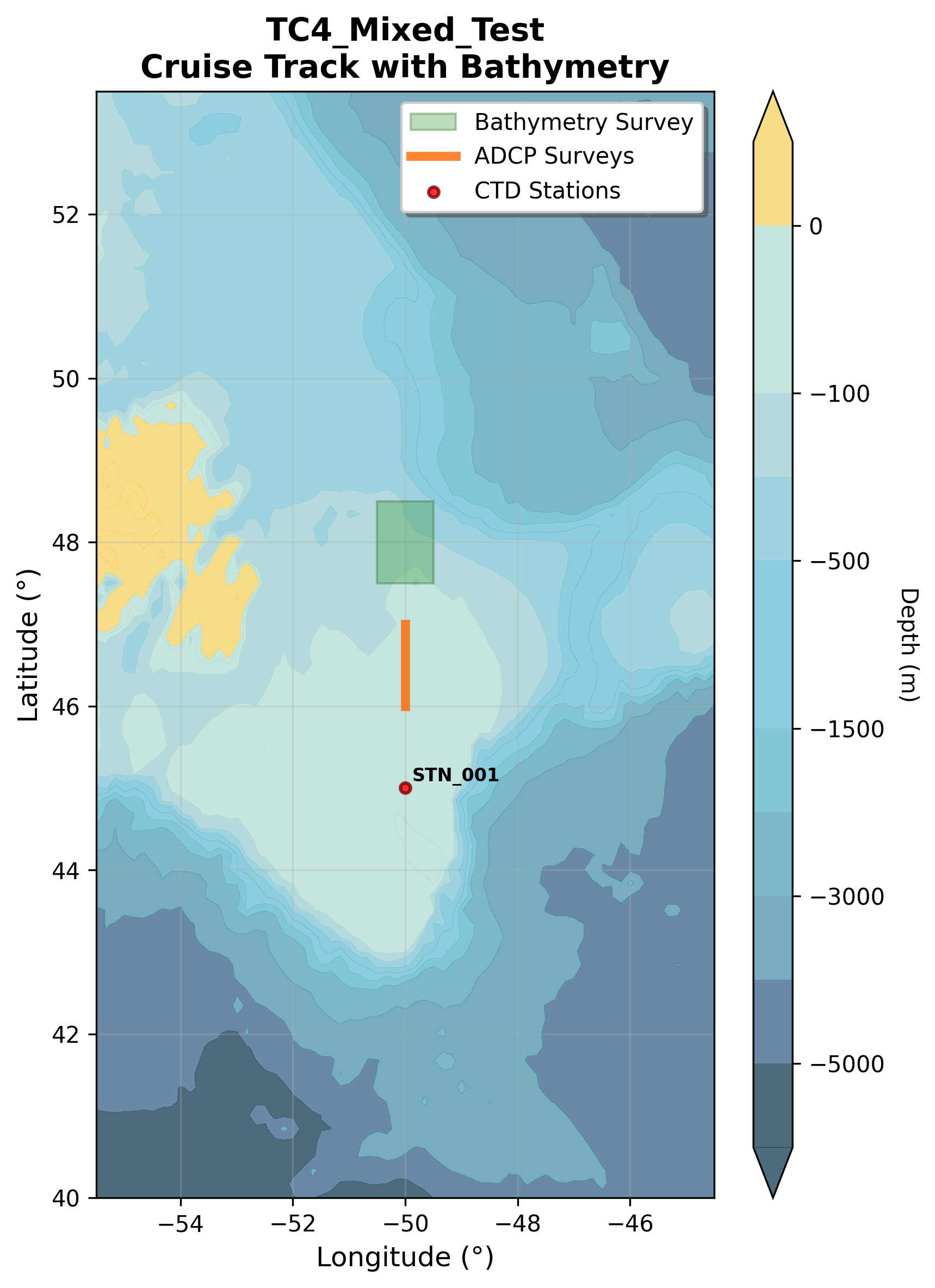
Station & STN-001 & 45$^\circ$00.00'N, 050$^\circ$00.00'W & 58 \\
Line (line) & ADCP-Survey & (46$^\circ$00.00'N, 050$^\circ$00.00'W) to (46$^\circ$00.00'N, 050$^\circ$00.00'W) & N/A \\
Area (None) & Area-01 & Center: 47$^\circ$30.00'N, 050$^\circ$30.00'W & Variable \\
Compare with the TC4_Mixed_Test_schedule.html for coordinates and depths.
Verify that the *_schedule.html shows total duration of 287.2 hours.
Verify that the total cruise shows 3 operations and the 3a. Mixed_Survey leg shows 3 operations.
Verify that the Transit to ADCP survey in 3a. Mixed_Survey shows a distance of 60.0 nm taking 6.0 hours.
Verify that the ADCP survey shows an entry position of 46.0000, -50.0000 and an exit position of 47.0000, -50.0000.
Verify that the *_work_days.tex shows total operation duration of 24.2 hours and transit duration of 258.5 hours.
\textbf{Total duration} & & \textbf{24.2} & \textbf{258.5} \\
Test Case 5: Sections (tc5_sections.yaml)
Purpose: Verify section-based definitions and expansions
Configuration:
Section expansion to individual stations
Verify that the _enriched.yaml contains individual stations instead of a section:
points:
-  #  expanded by cruiseplan enrich --expand-sections
   name: SEC_001_Stn001
   coordinates_ddm: 45 00.00'N, 050 00.00'W
   water_depth: 58.0
   operation_type: CTD
   action: profile
   latitude: 45.0
   longitude: -50.0
   comment: Station 1/14 on SEC_001 section
   duration: 120.0
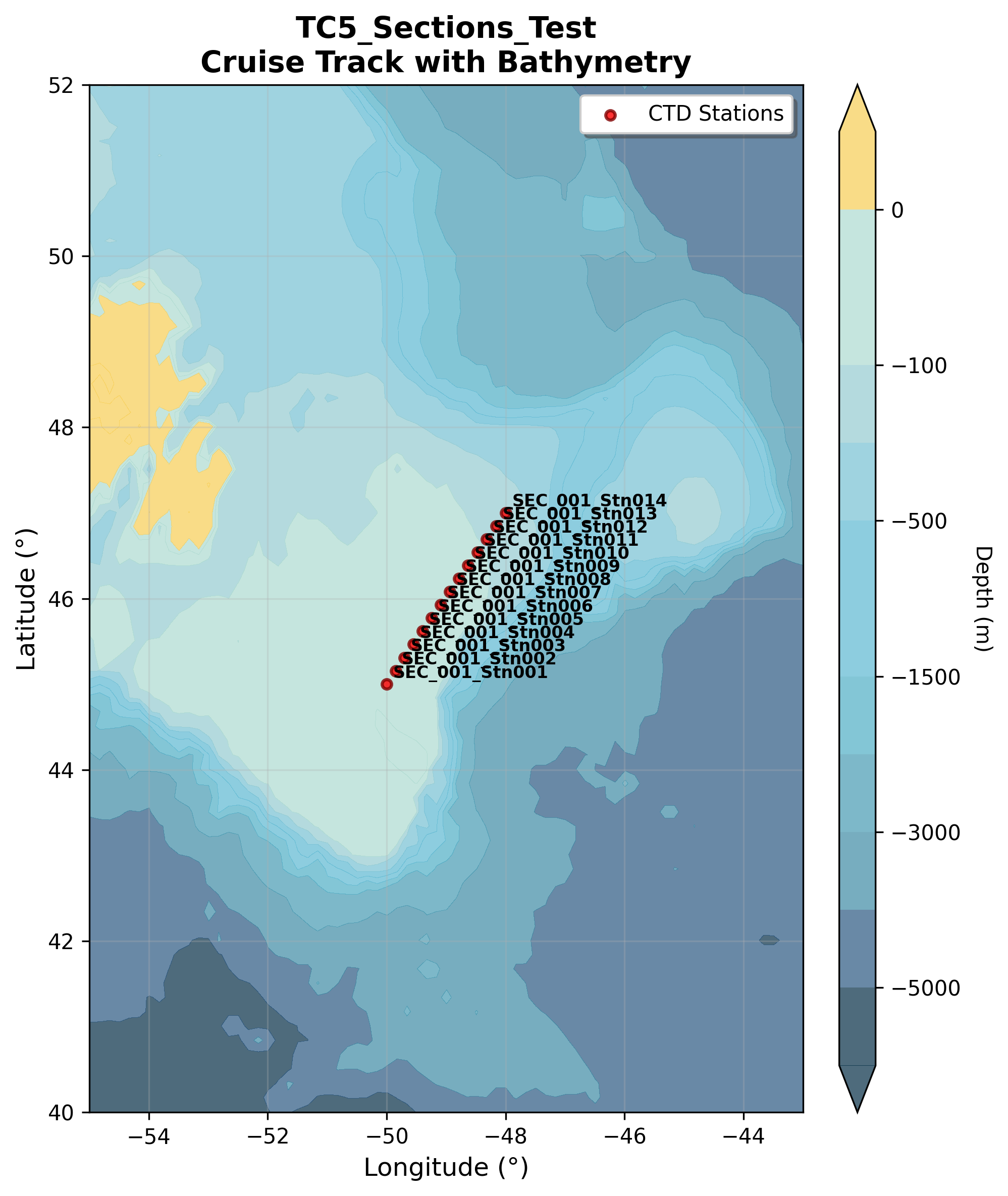
Verify that the _map.png shows all 14 stations from the section TC5_Sections_Test_map.png
Verify that the _schedule.html shows a station spacing of 11.2 nm.
Additional Test Files
Mooring-focused: tc1_mooring.yaml
- Mooring-specific operation testing
- Extended duration operations
Running Manual Tests
Automated Testing
The primary method for running all tests:
# From repository root
python test_all_fixtures.py
This script:
Finds all test fixtures: Processes all
tc*.yamlfiles intests/fixtures/Runs process command: Creates enriched configurations with depths and coordinates
Runs schedule command: Generates complete cruise schedules
Validates outputs: Checks that expected files are created
Reports results: Provides summary of successes and failures
Individual Test Execution
For detailed testing of specific scenarios:
# Test a specific fixture
cruiseplan process -c tests/fixtures/tc1_single.yaml --output-dir tests_output/manual
cruiseplan schedule -c tests_output/manual/TC1_Single_Test_enriched.yaml --output-dir tests_output/manual

# Verify outputs
ls tests_output/manual/
Manual Verification Steps
After running automated tests, manually verify:
1. File Generation:
ls tests_output/fixtures/
# Should show:
# - *_enriched.yaml files
# - *_timeline.html files
# - *_timeline.csv files
# - *_map.png files (if map generation enabled)
2. Content Validation:
Here, I am currently manually checking against offline calculations, especially for speeds and durations.
3. Error Checking:
# Run with verbose output to check for warnings
cruiseplan process -c tests/fixtures/tc1_single.yaml --verbose
Development Workflow Integration
Pre-Commit Testing
Before committing changes that affect core functionality:
# Run full test suite
python test_all_fixtures.py

# Check for any new warnings or errors
cruiseplan process -c tests/fixtures/tc3_clusters.yaml --verbose
Release Testing
Before creating releases:
Run all automated tests:
python test_all_fixtures.pyManual verification: Check complex scenarios manually
Performance testing: Time execution of large configurations
Documentation sync: Ensure test results match documented behavior
Troubleshooting
Common Issues
Missing Bathymetry Data:
# Download required bathymetry
cruiseplan bathymetry --bathy-source etopo2022
Output Directory Permissions:
# Ensure output directory is writable
mkdir -p tests_output/fixtures
chmod 755 tests_output/fixtures
Fixture File Issues:
# Validate YAML syntax
python -c "import yaml; yaml.safe_load(open('tests/fixtures/tc1_single.yaml'))"
Test Results Interpretation
Success Criteria:
- All tc*.yaml files process without errors
- Enriched YAML files are created with expected structure
- Schedule generation completes for all fixtures
- Output files contain expected content
Warning Evaluation: - Deprecation warnings are acceptable during transition periods - Missing bathymetry warnings are expected without data downloads - Port reference warnings are normal for test fixtures
Failure Investigation: - Check recent code changes affecting failing components - Verify test fixture validity - Review error messages for specific issues - Test individual commands to isolate problems
Extending the Test Suite
Adding New Test Cases
To add new manual test scenarios:
Create fixture file:
tests/fixtures/tcX_description.yamlFollow naming convention: Use
tcprefix with descriptive nameTest automatically: New files are included in
test_all_fixtures.pyautomaticallyDocument purpose: Add description to this document
Test Case Design Guidelines
Progressive Complexity: - Start with simple scenarios - Add one complexity dimension per test case - Build on previous test case concepts
Feature Coverage: - Each major feature should have dedicated test coverage - Edge cases and error conditions should be represented - Real-world scenarios should be included
Maintainability: - Use clear, descriptive names - Include comments explaining test purpose - Keep configurations as simple as possible while testing target features
This manual testing framework ensures that CruisePlan maintains reliability and functionality across development cycles while providing clear procedures for validation and troubleshooting.